
Why 'On Sale' Doesn't Always Mean You're Saving Money
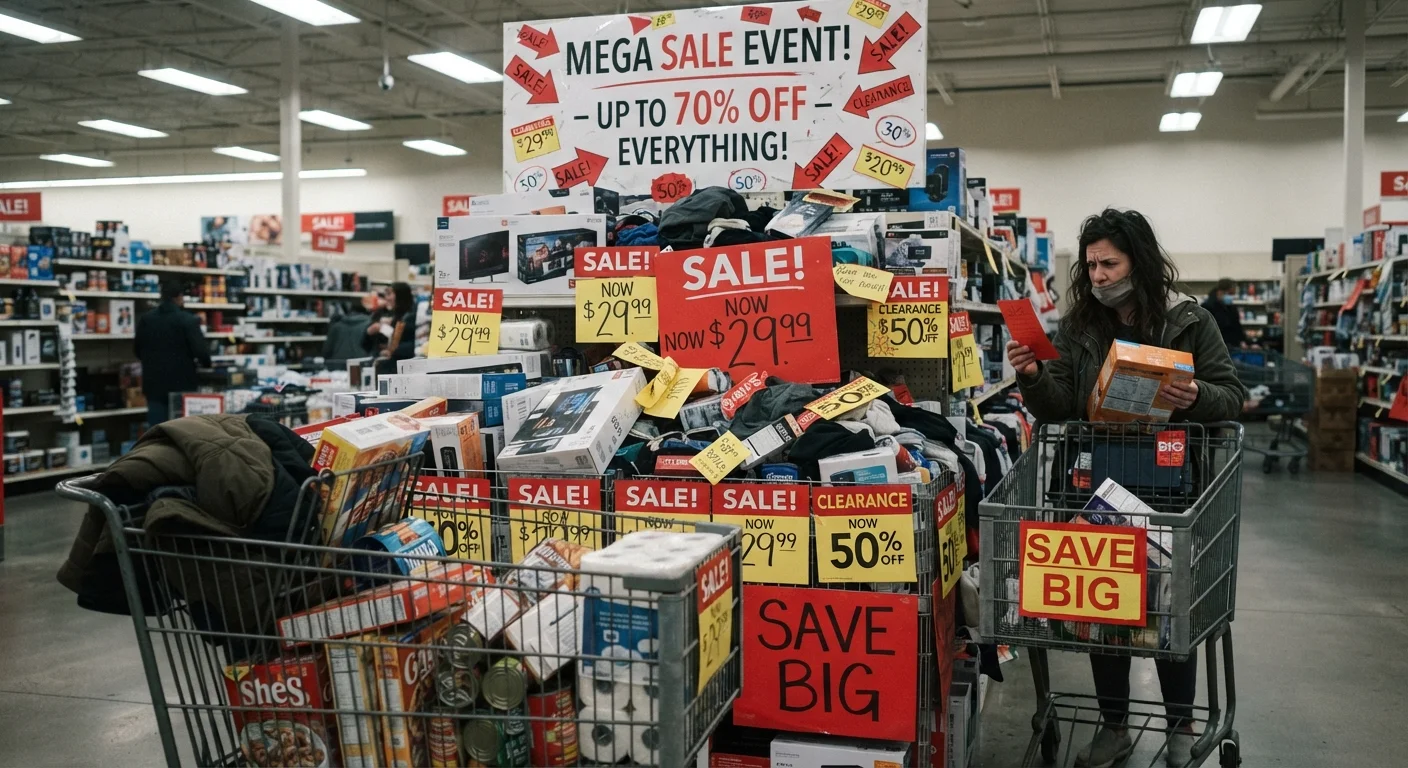
Photo credit: ResultsRover.com | Insights You Can Trust
In this article
Discounts can obscure inflated original prices and anchor your expectations. Here's how to evaluate a sale on its actual merits.
Key Takeaways
- Retailers can legally inflate a reference price to make a discount appear larger than it actually is.
- Anchoring bias causes shoppers to evaluate deals relative to a stated original price, even when that price is misleading.
- The only meaningful measure of a deal is what the item typically sells for across multiple sellers over time.
- Sale urgency tactics — countdown timers, limited stock warnings — often have no basis in actual scarcity.
- Comparing unit prices and researching price history are the two most reliable ways to evaluate a discount.
The Gap Between 'Was' and 'Worth'
Walk through any major retailer and you'll see the same formula: a crossed-out "original" price beside a bolder, lower number. The implied message is simple — you're saving the difference. But that math only holds if the original price was ever real. Frequently, it isn't.
Retailers have long used a practice called reference pricing — displaying a higher "was" or "list" price alongside the sale price to anchor your perception of value. The Federal Trade Commission has noted that a reference price is only meaningful if the item was genuinely offered at that price for a substantial time. In practice, many items are tagged at inflated list prices that almost no one pays, purely to make the markdown look dramatic.
Understanding what "retail price" actually means is the first step toward not being misled. MSRP (Manufacturer's Suggested Retail Price) is a suggestion, not a record of what anyone paid. When a television is "marked down" from its MSRP to a price it has sold at for six months, the sale is cosmetic.
Common Myths About Sales, Corrected
These misconceptions are widespread — and expensive. Recognizing them shifts you from a reactive buyer into a deliberate one.
Myth
If something is on sale, I'm automatically saving money compared to what I'd otherwise pay.
Fact
You're only saving money if the sale price is lower than what you would realistically have paid without the promotion.
A sale price is meaningful only relative to an honest market price — what the item actually trades for across sellers and over time. When a retailer sets an inflated "regular" price that few or no customers ever paid, then discounts from that baseline, the savings are largely fictional. The real comparison point is the price you'd find through normal shopping, not the number that's been crossed out.
Myth
A higher original price signals that the product is higher quality.
Fact
Original or list prices are set by sellers and manufacturers, and often have little connection to production cost or quality.
Price is partly a signal — but it's a signal that sellers control and routinely manipulate. Research in consumer behavior consistently shows that people infer quality from price, which is exactly why inflated reference prices are effective marketing tools. Price and value are not the same thing, and a markdown from an artificially high starting point tells you nothing about how good the product actually is.
Myth
Urgency signals like 'limited time' or 'only a few left' mean I should act fast or miss out.
Fact
Scarcity and deadline messaging are standard retail conversion tactics that frequently don't reflect actual inventory or pricing constraints.
Artificial scarcity is a well-documented sales technique. Countdown timers on e-commerce pages often reset; "limited stock" warnings may appear regardless of warehouse levels. These signals are designed to short-circuit comparison shopping by raising the emotional cost of waiting. When you feel urgency, slow down — that's the moment the tactic is working on you.
Myth
Buying more units during a sale always saves money in the long run.
Fact
Bulk buying during a sale only saves money if you'll use the product before it expires or degrades, and if the per-unit price is genuinely lower.
Stocking up on a perishable you won't finish, or buying multiples of something whose price will drop further next month, erases any discount benefit. The relevant calculation is unit cost multiplied by actual usage, not the percentage-off badge. Evaluating whether a discount reflects real savings requires knowing both the true unit price and your actual consumption rate.
Myth
Sale prices are lower than what you'd find elsewhere at the same time.
Fact
A "sale" price at one retailer is often comparable to or higher than the everyday price at competing sellers.
Retailers operate independently, and what one calls a sale price another may call its standard price. Without cross-retailer comparison, a sale tag is just a label. This is especially common in categories like electronics, bedding, and cookware, where suggested list prices are routinely set far above competitive market prices. Checking at least two or three sources before purchasing is the simplest defense against this.
How to Actually Evaluate a Discount
Ignoring the stated original price sounds counterintuitive, but it's the most practical starting point. Instead, focus on what the item has actually sold for elsewhere and over time.
37%
Shoppers who check prices before buying
A Pew Research Center survey found only about 37% of American adults consistently compare prices across stores before making a purchase.
~60%
Online retail prices that change frequently
Academic studies of e-commerce pricing have found that a significant share of listed prices on major platforms change at least once per month, making static "original" prices unreliable benchmarks.
- Check price history tools. Browser extensions and dedicated sites track how a product's price has moved on major platforms. A "50% off" item that has been at its current price for four months is not discounted — it's just labeled.
- Compare unit prices. For groceries and household goods, the shelf tag often includes a unit price (cost per ounce, per sheet, per count). Unit pricing lets you compare across sizes and brands on equal terms — a sale package can still be more expensive per unit than the non-sale alternative.
- Know the category's price cycle. Most product categories follow predictable markdown patterns. Seasonal sale cycles can tell you when a category genuinely tends to drop in price versus when a "sale" is just standard pricing dressed up.
- Ignore urgency signals. Countdown timers and "only 3 left" notices are standard conversion tactics, not reliable indicators of scarcity. These tactics are designed to be invisible — naming them is how you neutralize them.
Don't Let Anchoring Work Against You
Anchoring bias — our tendency to rely heavily on the first number we see — is one of the most reliably documented effects in behavioral economics. When a price tag shows $200 crossed out and $120 in bold, your brain treats $200 as the reference point, making $120 feel like a gain even if $120 is simply the item's normal price. Being aware of this effect doesn't fully neutralize it, but pausing to ask "what would I pay for this if I hadn't seen that crossed-out price?" gives you a more honest baseline.
Paying less than a stated original price is not, by itself, saving money. Saving money means paying less than you would have otherwise, for something you actually need, at a price that reflects genuine market value. That's a higher bar — and a more useful one. For a broader look at how sale psychology fits into everyday spending decisions, see our piece on smart spending myths that keep people from saving.

Author
Smart Shopping Editorial Team
Smart Shopping Editorial Team is the collective byline for our editorial team and contributor network. Articles published under this byline or an editorial pen name are researched, written, and reviewed according to our editorial standards for clarity, consistency, and independence before publication.
View all articles →