
Attic Insulation: What the R-Value Rating Actually Tells You
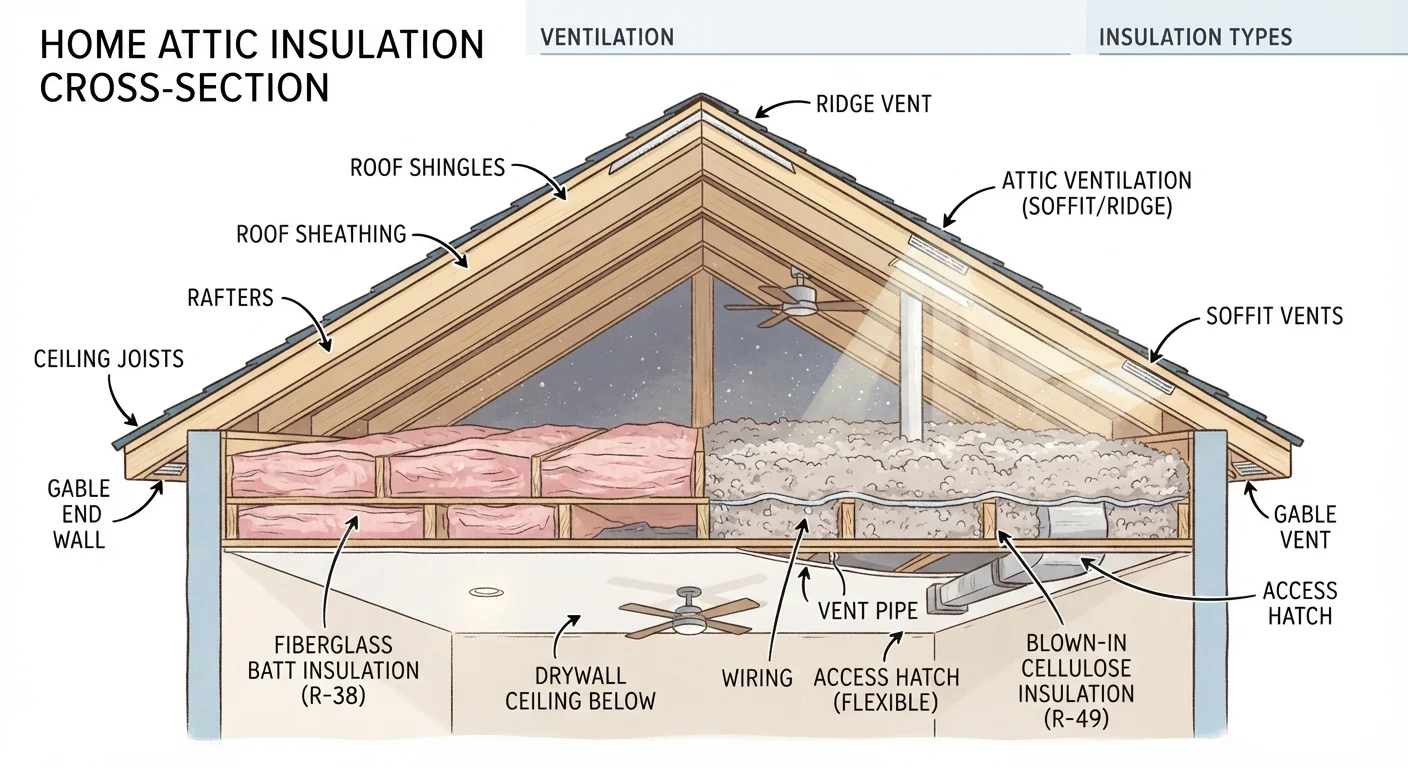
Photo credit: ResultsRover.com | Insights You Can Trust
In this article
R-value measures thermal resistance, but the right number depends on your climate zone and attic type. Here's what homeowners need to know.
Key Takeaways
- R-value measures thermal resistance - higher numbers mean stronger insulation performance.
- The Department of Energy recommends different R-values depending on your climate zone.
- Most U.S. attics are underinsulated; adding insulation on top of existing material is often straightforward.
- Air sealing before adding insulation dramatically improves overall thermal performance.
- Different insulation types - batts, blown-in, spray foam - can achieve the same R-value through different means.
What R-Value Actually Measures
When you see a bag of insulation labeled "R-38" at a hardware store, that number tells you one specific thing: how strongly the material resists heat moving through it. It does not tell you how thick the material is, what it's made of, or how long it will last - just its thermal resistance.
Heat naturally flows from warmer areas to cooler ones. In winter, that means heat tries to escape through your attic floor into the cold attic space above. In summer, the reverse happens - heat pushes down from a scorching attic into your cooled living space below. Insulation slows both of those movements. The R-value number quantifies exactly how much resistance it provides.
One important nuance: R-value is additive. If you have R-19 of existing insulation and add R-19 more on top, you end up with roughly R-38 total. This is why topping up an underinsulated attic is often a practical first step rather than a full replacement project.
R-Value Is Measured Per Material, Not Per Attic
The R-value on an insulation package reflects the product under controlled laboratory conditions. Your attic's total effective thermal resistance depends on consistent coverage, absence of air gaps, and whether air sealing has been done. Two attics with the same labeled R-value can perform very differently based on installation quality.
Why Climate Zone Determines the Right R-Value
There is no single correct R-value for every American home. The U.S. Department of Energy divides the country into eight climate zones, ranging from hot-humid Florida and the Southwest to the frigid Upper Midwest and New England. Each zone has a recommended R-value range for attics.
In Climate Zone 1 (the warmest), an R-30 to R-49 attic is typically sufficient. By the time you reach Climate Zone 7 - places like northern Minnesota or Alaska - the recommendation climbs to R-49 to R-60. Homes in the middle of the country, such as the mid-Atlantic or Midwest, generally fall in the R-38 to R-49 range.
The logic is straightforward: the greater the temperature difference between inside and outside, the harder your insulation must work. A home in Phoenix, Arizona, faces intense summer heat loads; a home in Minneapolis faces brutal winter cold. Each demands insulation calibrated to its specific challenge.
90%
U.S. homes estimated to be underinsulated
According to the North American Insulation Manufacturers Association, roughly 9 in 10 American homes lack adequate insulation levels.
R-49 to R-60
Recommended attic R-value for coldest U.S. climate zones
The U.S. Department of Energy's guidelines target Climate Zones 6-8, covering much of the northern tier of the country.
15%
Potential heating and cooling savings from proper insulation
The EPA's ENERGY STAR program estimates that properly air sealing and insulating can save approximately 15% on typical heating and cooling costs, though results vary by home.
Insulation Types and How They Achieve Their R-Values
Different insulation materials reach their R-values through different physical properties, and each type suits certain attic configurations better than others.
- Fiberglass batts: Pre-cut panels that fit between joists. R-value per inch is roughly 2.2-2.7. Easy for DIY installation in open, unobstructed attics.
- Blown-in fiberglass or cellulose: Loose fill material blown in by machine, ideal for topping up existing insulation or covering irregular spaces. Cellulose runs about R-3.2-3.8 per inch; fiberglass loose fill is slightly lower.
- Spray polyurethane foam: Applied as a liquid that expands and hardens, often used in cathedral ceilings or when air sealing and insulating simultaneously is a priority. R-value per inch is higher - around R-3.7 for open-cell and R-6-7 for closed-cell - but professional installation is generally required.
- Rigid foam boards: Used less commonly in attics but useful for insulating the underside of a roof deck in conditioned attic applications.
For most standard attics with accessible joist bays, blown-in or batt insulation installed to the correct depth is a practical and proven approach. See our broader guide to insulation and air sealing for a look at how these choices fit into a full energy-efficiency plan.
Check Depth Before Buying More Insulation
Most insulation bags include a coverage chart that shows how deep the material needs to be to achieve a given R-value. Use a ruler or tape measure to check your current attic insulation depth before purchasing anything. This prevents over- or under-buying and gives you a concrete starting point for your project.
What R-Value Cannot Tell You
R-value is a lab measurement taken under ideal, steady-state conditions. Real attics are messier. A few important limitations to keep in mind:
Air leaks bypass insulation entirely. Gaps around recessed lights, attic hatches, and where walls meet the ceiling allow conditioned air to escape directly - no R-value stops that. Air sealing those pathways before adding insulation is widely considered the more impactful first step. Just as a high-rated HVAC filter means little if your duct system leaks - a concept explored in our HVAC filter ratings explainer - R-value alone doesn't guarantee energy savings.
Compression reduces performance. Batts squeezed into too-tight spaces lose R-value. Moisture damage from a roof leak can degrade loose-fill insulation significantly.
Installation quality matters. Gaps, voids, and inconsistent coverage reduce effective R-value across an area even when individual batts carry a high rating. Even coverage across the full attic floor is essential.
Understanding these limits helps you make smarter decisions - and explains why a professional energy audit, which uses tools like blower-door tests and thermal imaging, often reveals performance gaps that a simple R-value label cannot.
Frequently Asked Questions

Author
Home & Garden Editorial Team
Home & Garden Editorial Team is the collective byline for our editorial team and contributor network. Articles published under this byline or an editorial pen name are researched, written, and reviewed according to our editorial standards for clarity, consistency, and independence before publication.
View all articles →