Unit Pricing Explained: The Number on the Shelf Tag That Most Shoppers Overlook
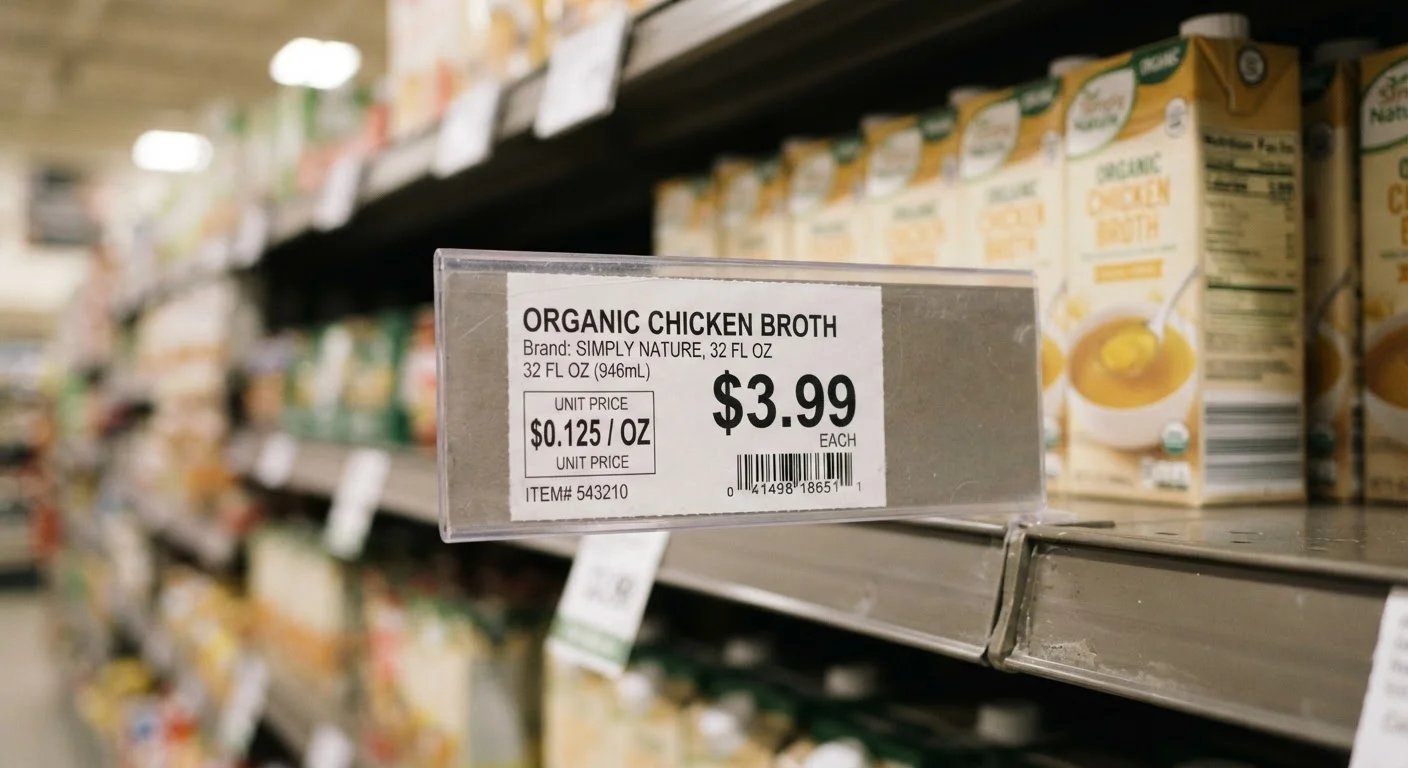
Photo credit: ResultsRover.com | Insights You Can Trust
In this article
Unit price tells you the true cost per ounce, count, or liter. Learn how to read it and use it to compare products accurately.
Key Takeaways
- Unit price converts product cost to a common measurement, making size-to-size comparisons accurate.
- Bigger packages are not always cheaper per unit — the math doesn't always favor bulk.
- Sale tags and promotional packaging can obscure the true per-unit cost.
- Most shelf tags already display the unit price; you just need to know where to look.
- Comparing unit prices takes seconds and can meaningfully reduce grocery bills over time.
Why the Total Price Is Only Half the Picture
Walk down any grocery aisle and you'll see dozens of products sold in different sizes — a 12-oz jar next to a 24-oz jar, a 6-pack next to a 12-pack. The total price tells you what you'll hand over at checkout. It does not tell you which option actually costs less per use.
That's exactly what unit price does. By converting every product to the same measuring stick — cost per ounce, cost per load, cost per sheet — it makes comparisons honest. Without it, a $4 bottle that looks cheaper than a $6 bottle might actually cost you more every time you use it.
This kind of confusion is one of the quieter ways grocery budgets get eroded. See our look at grocery spending habits for the full picture of where supermarket dollars silently disappear.
~$1,500
Annual grocery overspend per household
Consumer research consistently estimates U.S. households spend significantly more than necessary on groceries due to comparison gaps and impulse decisions, with figures commonly cited in this range by financial wellness analysts.
32
U.S. states with unit pricing requirements
According to consumer advocacy research, roughly 32 U.S. states have some form of unit pricing law for packaged goods, though coverage and enforcement vary considerably.
How to Read a Shelf Tag Correctly
A standard U.S. grocery shelf tag typically shows three things: the product name, the total retail price (large, prominent), and the unit price (smaller, often in a corner). The unit price will look something like $0.19/oz or $2.14/lb or $0.04/ct (ct = count).
To use it, simply compare the unit prices of products you're considering. Lower unit price = less money spent per ounce, per use, or per item. That's the whole method.
If the tag doesn't show a unit price, calculate it yourself: divide the total price by the number of units (ounces, count, etc.) shown on the package. A $3.49 bottle containing 18 oz works out to about $0.19 per ounce. A $2.99 bottle with 12 oz costs roughly $0.25 per ounce — more expensive despite the lower sticker price.
Use Your Phone When Tags Are Missing
Not every store displays unit prices clearly, and some categories are exempt from requirements. Keep your phone's calculator app handy: divide the shelf price by the number of ounces, count, or other units on the package. The math takes under 10 seconds and gives you the same information a tag would.
The Bulk Assumption — and When It's Wrong
Most shoppers assume bigger is cheaper. Often it is — but not always. Retailers price products strategically, and the jumbo size isn't automatically the best value. Promotional pricing on a mid-size item, store-brand pricing, or a sale on a smaller package can flip the math entirely.
Unit pricing removes the guesswork. It also protects you from another common trap: "sale" tags that highlight a discount without telling you whether the per-unit cost is actually competitive. A 20% discount on an overpriced product may still leave you paying more per ounce than the non-sale alternative right next to it. For more on that dynamic, see why sale tags don't always mean savings.
Beyond the Grocery Store: Unit Pricing in the Real World
Unit pricing logic extends to nearly any purchase involving quantity or size decisions. At a hardware store, comparing price per square foot on tile or price per linear foot on lumber works the same way. At a pharmacy, price per dose on vitamins or OTC medications is more useful than sticker price. Online, where pack sizes vary wildly, per-unit cost is often the only reliable comparison point.
The broader principle — that the number on the label isn't always the number that matters — applies to major purchases too. Just as unit price corrects for package size, understanding price versus value corrects for quality, lifespan, and actual usefulness.
Unit pricing is one of the fastest habits to build. Once you start checking that small number on the shelf tag, it takes only a few seconds per purchase — and those seconds routinely surface savings that add up across a full shopping trip.
This article is for general informational purposes only and does not constitute financial or purchasing advice tailored to your individual situation.
Frequently Asked Questions

Author
Personal Finance Editorial Team
Personal Finance Editorial Team is the collective byline for our editorial team and contributor network. Articles published under this byline or an editorial pen name are researched, written, and reviewed according to our editorial standards for clarity, consistency, and independence before publication.
View all articles →