
Digital Coupons vs. Paper Coupons: What's Actually Different Beyond the Format
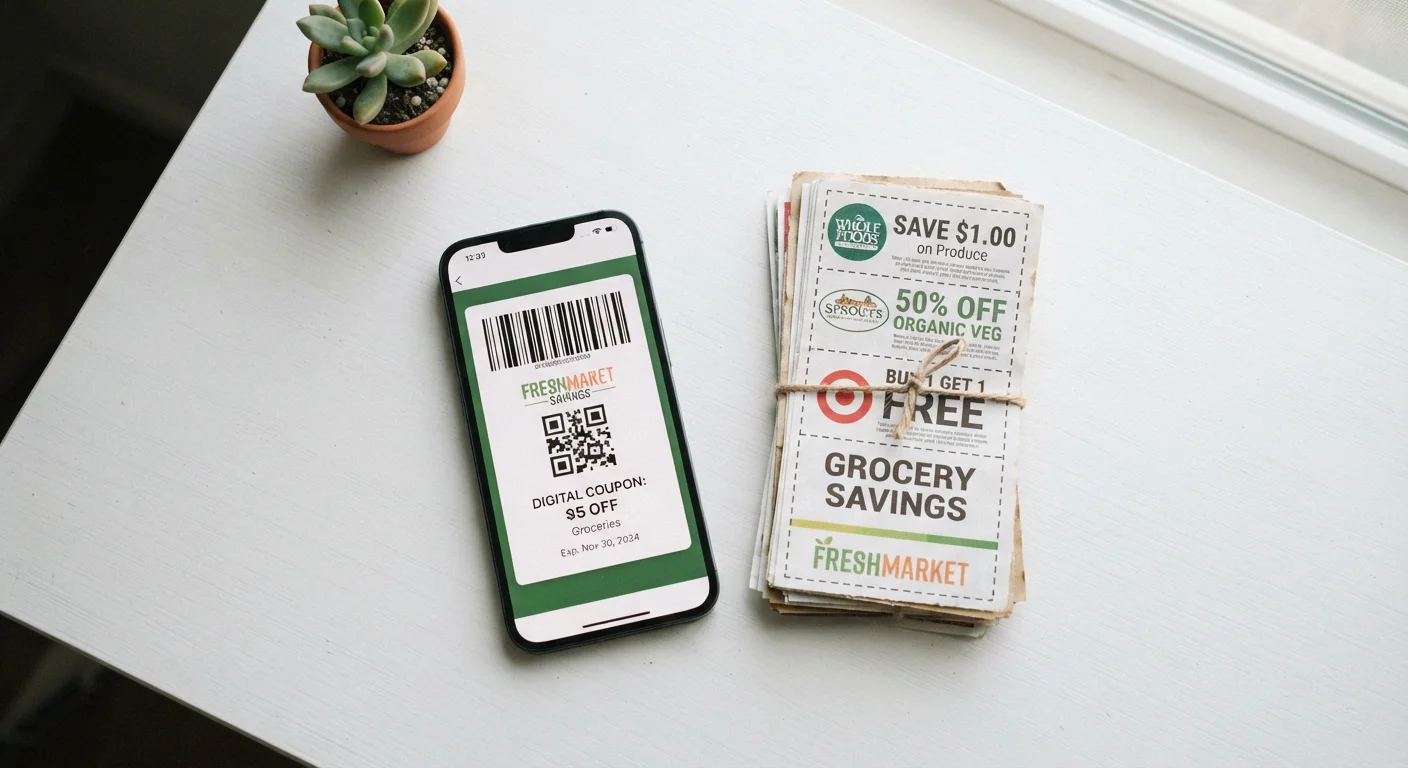
Photo credit: ResultsRover.com | Insights You Can Trust
In this article
Digital and paper coupons aren't interchangeable. See how they differ in acceptance, stacking rules, expiration, and ease of use.
Key Takeaways
- Digital coupons are often store-specific and auto-apply at checkout, removing manual steps but limiting flexibility.
- Paper coupons — including manufacturer coupons — can sometimes be used across multiple retailers, giving more flexibility.
- Stacking rules differ significantly: some stores allow layering digital and paper, others don't.
- Digital coupons typically expire without notice; paper coupons display expiration dates visibly.
- Acceptance of paper coupons, particularly printable ones, has narrowed at many retailers in recent years.
- Understanding the type of coupon — manufacturer versus store — matters more than the format it comes in.
The Format Is the Least Important Difference
Most people assume digital and paper coupons are simply the same discount delivered through different channels. They're not. The format is almost incidental — what actually varies is who issues the coupon, where it can be redeemed, how it's validated, and what rules govern combining it with other offers.
If you're just getting started, the primer on how coupons and deals work is worth reading first. But if you already understand the basics and want to know why one format sometimes saves more than the other, that answer lives in the mechanics — not the medium.
The single most important distinction isn't digital vs. paper. It's manufacturer coupon vs. store coupon. A manufacturer coupon is issued by the product maker and reimbursed through a clearinghouse; it can generally be used at any retailer that accepts that coupon type. A store coupon is issued by a specific retailer and is only valid there. Both formats — digital and paper — can be either type, but the issuer determines where the coupon is actually accepted.
| Criterion | Digital Coupons | Paper Coupons |
|---|---|---|
| Issuer type | Usually store-issued (loyalty app) | Manufacturer or store-issued |
| Retailer flexibility | Single store only | Manufacturer coupons usable at multiple retailers |
| Expiration visibility | Often buried in app; no reminder | Printed on coupon face |
| Fraud risk to retailers | Lower — tied to account | Higher — printable coupons especially |
| Stacking potential | Store coupon layer; pairs with manufacturer paper | Manufacturer layer; pairs with store digital |
| Checkout ease | Auto-applies with loyalty card or app | Must present physically at register |
| App or account required | Yes | No |
| Acceptance trends | Growing, especially in grocery | Declining for printable; inserts still widely accepted |
Acceptance, Stacking, and the Rules That Catch Shoppers Off Guard
Paper manufacturer coupons have historically enjoyed broad acceptance across grocery chains, drugstores, and mass retailers. That flexibility is narrowing. Many stores have tightened policies on printable coupons specifically — some no longer accept them at all due to fraud concerns. Which retailers still accept printable coupons depends heavily on the chain and the region.
Digital coupons, by contrast, are almost always store-specific — clipped within a retailer's app or loyalty account and applied only at that store. The upside: they're harder to counterfeit and usually apply automatically. The downside: you're locked into that retailer for the deal.
Stacking — combining multiple discounts on one item — is where format really starts to matter. Many stores permit one manufacturer coupon plus one store coupon per item. If the manufacturer coupon exists in paper form and the store coupon is digital, you may be able to use both. However, two manufacturer coupons on the same item — regardless of format — is almost universally prohibited. For a detailed breakdown of how layering works without running afoul of store policy, see how to stack coupons, codes, and rewards.
Digital Expiration: A Silent Savings Killer
Digital coupons clipped in store apps frequently expire within one to two weeks of being added — and most apps don't send expiration reminders. It's worth building a habit of reviewing clipped offers before each shopping trip rather than assuming they'll be there when you need them. Some apps display expiration dates in the offer detail view, but not always prominently.
One practical gap that catches shoppers: digital coupons often disappear from your account once they've been applied — or once they expire — without any notification. Paper coupons show their expiration date on the face of the coupon. If you're tracking multiple digital offers across several apps, missed expirations can quietly eliminate savings you planned to use.
Practical Trade-offs Worth Knowing Before You Checkout
Digital coupons win on convenience. You clip once in an app, and the discount applies at checkout without any action required at the register. There's no physical item to carry, no concern about a cashier misreading a barcode, and no risk of leaving the coupon at home. For routine grocery shopping at a store where you already have a loyalty account, digital offers are the path of least resistance.
Paper coupons win on flexibility and transparency. A manufacturer's insert coupon can often be used wherever you find the best shelf price that week — not just at the store where the deal originated. You can also see exactly what terms apply: purchase minimums, eligible product sizes, and expiration dates are printed on the face of the coupon.
91%
Consumers using digital coupons in a recent year
According to Statista consumer survey data, digital coupon adoption among U.S. shoppers has risen sharply over the past decade.
47B+
Paper coupons distributed annually in the U.S.
Industry data from Kantar and Valassis has consistently tracked billions of paper coupon distributions annually, predominantly through Sunday inserts.
Less than 1%
Average paper coupon redemption rate
Research from coupon clearinghouses indicates paper coupon redemption rates have remained well below one percent of coupons distributed for decades.
The choice between formats also connects to broader strategy. If you're focused on combining discount types — coupons alongside cash-back offers or promo codes — understanding what each mechanism actually does is foundational. How coupons, promo codes, and cash back each work differently affects which combinations are possible and which stores allow them.
Neither format is universally superior. Shoppers who get the most consistent savings tend to use both: digital offers clipped within store apps for predictable weekly purchases, and paper or printable manufacturer coupons kept in reserve for price-matching or cross-retailer flexibility. For more frameworks on spending smarter across everyday purchases, the Smart Spending hub covers the broader picture.

Author
Smart Shopping Editorial Team
Smart Shopping Editorial Team is the collective byline for our editorial team and contributor network. Articles published under this byline or an editorial pen name are researched, written, and reviewed according to our editorial standards for clarity, consistency, and independence before publication.
View all articles →