
Reading Pet Food Labels: Ingredients, Guaranteed Analysis, and What to Ignore
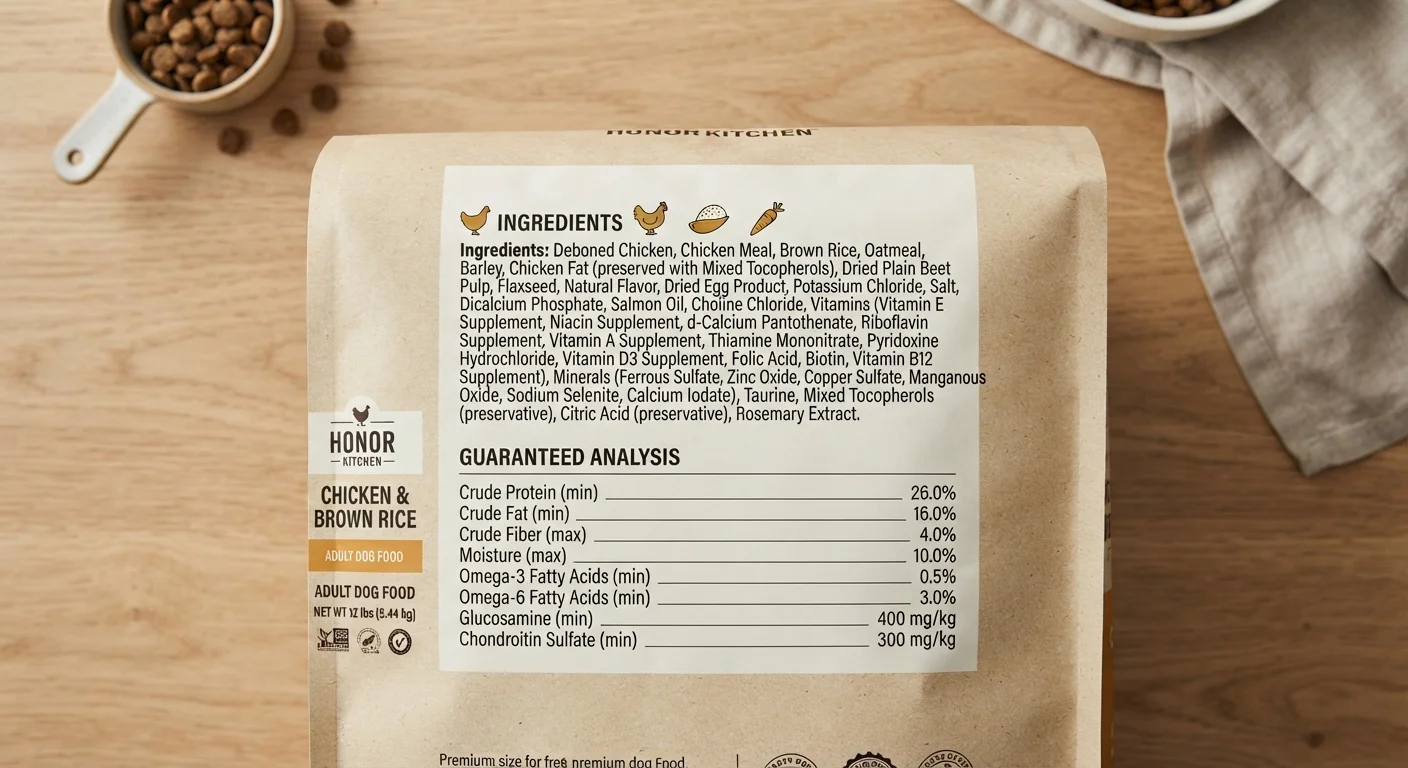
Photo credit: ResultsRover.com | Insights You Can Trust
In this article
Pet food packaging can be confusing and sometimes misleading. Here's a practical guide to understanding what the label actually tells you about nutrition.
Key Takeaways
- Ingredients are listed by pre-cooking weight, so moisture content can make meat appear higher than it truly is.
- The Guaranteed Analysis shows minimum or maximum nutrient percentages, not exact values.
- Marketing terms like 'natural,' 'premium,' and 'holistic' have no regulated nutritional meaning on pet food labels.
- An AAFCO nutritional adequacy statement tells you whether a food is complete and balanced for your pet's life stage.
- Ingredient splitting can make less desirable ingredients appear lower on the list than they actually are.
- When in doubt about your pet's specific dietary needs, consult a licensed veterinarian or veterinary nutritionist.
Why Pet Food Labels Are Harder to Read Than They Look
Pet food packaging is designed to sell as much as it is to inform. Bold claims on the front panel — words like "grain-free," "natural," or "real chicken" — are largely marketing language. The useful information is on the back or side of the package, in two specific places: the ingredient list and the Guaranteed Analysis. Learning to read those two sections is the most practical nutrition skill you can develop as a pet owner.
For broader context on everyday pet care basics, these label-reading skills fit into a larger picture of preventive wellness. Much like decoding a human nutrition label, the pet food version has its own logic — once you know the rules, you can cut through the noise quickly.
What you will need
What the Ingredient List Actually Tells You
Ingredients are listed in descending order by weight before cooking. This matters because raw chicken, for example, is roughly 70% water. After processing, the actual protein contribution may be smaller than it appears. A food listing "chicken" first followed by several grain or starch ingredients may derive more of its total protein from those sources once moisture is removed.
Watch for ingredient splitting: a manufacturer may list "ground corn," "corn gluten meal," and "corn flour" as separate entries. Individually, each appears lower on the list — but combined, corn could outweigh the named protein source. This is a legal practice, so awareness is your best tool.
Named protein sources ("chicken," "salmon," "beef") are more traceable than vague terms like "meat meal" or "poultry by-product meal." By-products are not necessarily harmful — organ meats can be nutritionally dense — but the term "meal" simply means the ingredient has been rendered and dried. Understanding this distinction lets you compare foods more honestly. See our companion piece on dry vs. wet food nutritional trade-offs for how processing method affects overall nutrient delivery.
Ingredient Lists Follow a Consistent Rule
Every commercially sold pet food in the U.S. must list ingredients in descending order by pre-cooking weight — this is a federal requirement, not a voluntary choice. Use this predictability to your advantage: the first ingredient is always the heaviest by raw weight, giving you a reliable starting point for comparison.
Decoding the Guaranteed Analysis
The Guaranteed Analysis (GA) panel lists four required values: minimum crude protein, minimum crude fat, maximum crude fiber, and maximum moisture. Notice that "minimum" and "maximum" are not the same as actual amounts — the real values could be higher or lower. This is a regulatory floor and ceiling, not a precise nutritional breakdown.
One important limitation: the GA uses an "as-fed" basis, meaning moisture is included. Comparing a wet food (which may be 78% moisture) to a dry kibble (around 10% moisture) using GA numbers alone is misleading. To make a fair comparison, you would need to convert both to a dry matter basis — a calculation that removes moisture from the equation. Your veterinarian can help interpret these numbers for your pet's specific needs.
The GA does not tell you amino acid profiles, vitamin levels, mineral ratios, or digestibility — all of which matter for long-term health. For a deeper look at how macronutrients function, our guide on protein, carbs, and fat explains the underlying science in plain language.
The Guaranteed Analysis Is Not a Full Nutritional Profile
The four values in the Guaranteed Analysis — protein, fat, fiber, and moisture — are the legal minimum required on U.S. pet food labels, but they do not capture amino acid completeness, vitamin content, mineral balance, or digestibility. A food can meet GA minimums and still be nutritionally inadequate for a pet with specific health needs. For animals with chronic conditions, allergies, or unusual dietary requirements, a consultation with a board-certified veterinary nutritionist provides a level of precision that no label can replace.
The AAFCO Statement: One Line Worth Finding
Somewhere on the label — often in small print near the GA — you should find a statement from the Association of American Feed Control Officials (AAFCO). It will say something like: " is formulated to meet the nutritional levels established by the AAFCO Dog Food Nutrient Profiles for all life stages."
This statement matters more than almost anything else on the package. It signals that the food either meets AAFCO's established nutrient profiles through formulation, or has passed feeding trials. Foods labeled "for supplemental feeding only" or "for intermittent use" are not complete and balanced diets and should not be a pet's sole food source.
Also look for the intended life stage: "growth" (puppies/kittens), "maintenance" (adult animals), "all life stages," or "senior." Feeding a puppy food formulated only for adult maintenance, or vice versa, can have real nutritional consequences over time. If you're unsure which life stage category fits your pet, a quick conversation with your vet is the most reliable path forward.
Life Stage Mismatch Can Affect Long-Term Health
Feeding a food formulated for the wrong life stage over an extended period may lead to nutritional imbalances. Puppies fed adult-only maintenance food may not receive adequate levels of certain minerals critical for bone development. If you are unsure which formula is appropriate, your veterinarian is the right resource — not the packaging claims alone.
What You Can Safely Ignore
Several terms on pet food packaging carry no regulated nutritional meaning and can be disregarded when evaluating quality:
- "Natural" — AAFCO defines this loosely; it does not mean organic, additive-free, or nutritionally superior.
- "Premium" or "Ultra-Premium" — No regulatory definition exists for these words.
- "Holistic" — Not a defined term in pet food regulation.
- "Human-grade" — Has a specific legal meaning only when the entire manufacturing process qualifies; often used loosely.
Front-panel imagery and flavor descriptors also follow specific rules worth knowing. A food labeled "Chicken Dog Food" must contain at least 95% chicken (excluding water). "Chicken Dinner" or "Chicken Entrée" need only contain 25%. "With Chicken" requires just 3%, and "Chicken Flavor" may contain no measurable chicken at all — only enough to be detectable. These naming rules come directly from AAFCO guidelines and are one of the clearest examples of how label language can mislead without technically lying.
For a parallel look at how specification language works across other consumer products, reading between the lines of product specs applies similar critical thinking to non-food purchases.
This article provides general educational information about pet food labeling and is not a substitute for personalized dietary advice from a licensed veterinarian or board-certified veterinary nutritionist. Always consult a qualified professional before making significant changes to your pet's diet, especially for animals with health conditions.

Author
Pets & Animals Editorial Team
Pets & Animals Editorial Team is the collective byline for our editorial team and contributor network. Articles published under this byline or an editorial pen name are researched, written, and reviewed according to our editorial standards for clarity, consistency, and independence before publication.
View all articles →