
No-Equipment Movement: What You Can Actually Accomplish With Bodyweight Exercise
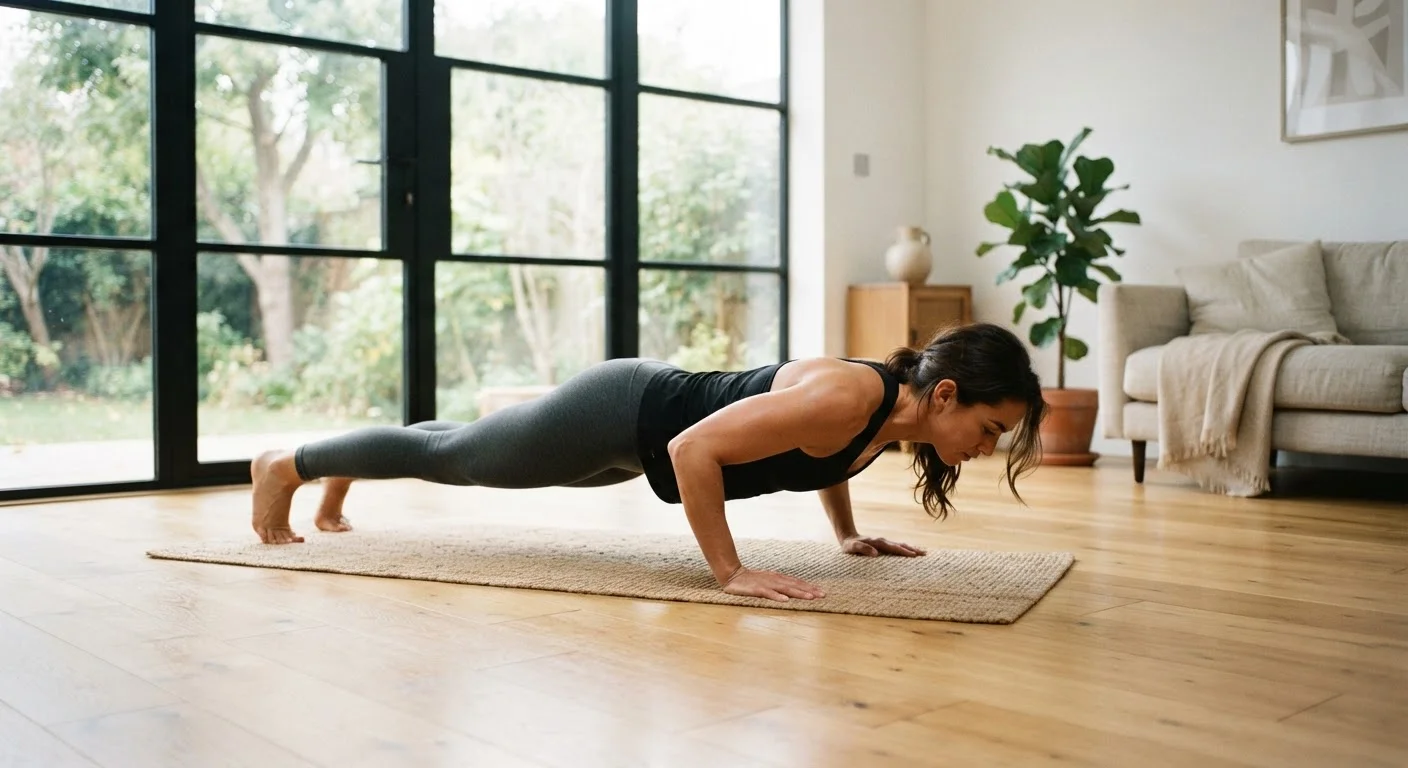
Photo credit: ResultsRover.com | Insights You Can Trust
In this article
Bodyweight training gets underestimated. Learn what it can and can't realistically do for your strength, endurance, and overall fitness.
Key Takeaways
- Bodyweight exercise can build real strength and endurance without any equipment.
- Progression becomes harder over time without added load, which limits long-term muscle growth.
- For busy Americans, the accessibility and zero cost of bodyweight training are genuine advantages.
- Combining bodyweight work with other movement types produces the most well-rounded fitness results.
Zero cost, available anywhere
No gym membership, equipment purchases, or travel time required. A consistent bodyweight routine can be completed in a living room, hotel room, or backyard.
Builds genuine functional strength
Compound bodyweight movements like push-ups, squats, and hip hinges train multiple muscle groups through full ranges of motion, developing strength that transfers to real-world activity.
Low barrier for beginners
Most bodyweight exercises are scalable - a push-up can start from the wall or knees - making them accessible for people at nearly any fitness level without intimidation or injury risk from unfamiliar machines.
Supports cardiovascular fitness
High-repetition circuits and high-intensity formats can sustain elevated heart rate, contributing to aerobic conditioning alongside muscular endurance.
Minimal injury risk when performed correctly
The absence of external load reduces the likelihood of dropped weights or mechanical overload. This makes bodyweight training a reasonable starting point for people returning to exercise after a break or injury.
Limited progressive overload ceiling
Without added external weight, increasing resistance requires exercise substitutions rather than simple load increments. This makes structured progression less straightforward and can stall muscle growth over time.
Insufficient for maximal strength or hypertrophy goals
For individuals whose primary goal is significant muscle mass or maximum strength output, bodyweight training alone is unlikely to provide sufficient stimulus beyond the intermediate level.
Lower-body loading is inherently limited
While single-leg variations like pistol squats increase difficulty, bodyweight lower-body exercises rarely replicate the loading available through barbells or machines, which matters for leg and glute development.
Requires more programming knowledge over time
Moving from beginner to intermediate bodyweight training demands understanding of exercise progressions and periodization - knowledge that isn't obvious without guidance or structured programs.
What Bodyweight Training Actually Is
Bodyweight exercise uses your own body mass as resistance - think push-ups, squats, lunges, planks, and pull-ups. No dumbbells, no cables, no machines. Because the resistance travels with you, the barrier to entry is essentially zero.
It's worth distinguishing bodyweight training from general movement. Structured bodyweight workouts apply progressive overload principles - gradually increasing difficulty through leverage, tempo, range of motion, or volume - the same core mechanism that makes any resistance training effective. For a broader look at how different exercise types train different qualities, see Types of Exercise and What Each One Trains.
Zero cost, available anywhere
No gym membership, equipment purchases, or travel time required. A consistent bodyweight routine can be completed in a living room, hotel room, or backyard.
Builds genuine functional strength
Compound bodyweight movements like push-ups, squats, and hip hinges train multiple muscle groups through full ranges of motion, developing strength that transfers to real-world activity.
Low barrier for beginners
Most bodyweight exercises are scalable - a push-up can start from the wall or knees - making them accessible for people at nearly any fitness level without intimidation or injury risk from unfamiliar machines.
Supports cardiovascular fitness
High-repetition circuits and high-intensity formats can sustain elevated heart rate, contributing to aerobic conditioning alongside muscular endurance.
Minimal injury risk when performed correctly
The absence of external load reduces the likelihood of dropped weights or mechanical overload. This makes bodyweight training a reasonable starting point for people returning to exercise after a break or injury.
Where Bodyweight Exercise Falls Short
Understanding the real limitations helps you plan around them rather than be surprised by them.
Limited progressive overload ceiling
Without added external weight, increasing resistance requires exercise substitutions rather than simple load increments. This makes structured progression less straightforward and can stall muscle growth over time.
Insufficient for maximal strength or hypertrophy goals
For individuals whose primary goal is significant muscle mass or maximum strength output, bodyweight training alone is unlikely to provide sufficient stimulus beyond the intermediate level.
Lower-body loading is inherently limited
While single-leg variations like pistol squats increase difficulty, bodyweight lower-body exercises rarely replicate the loading available through barbells or machines, which matters for leg and glute development.
Requires more programming knowledge over time
Moving from beginner to intermediate bodyweight training demands understanding of exercise progressions and periodization - knowledge that isn't obvious without guidance or structured programs.
The core issue is progressive overload. Muscles adapt to a stimulus and then stop responding to it. With free weights, you add five pounds. With bodyweight, you must change the exercise itself - moving from a standard push-up to an archer push-up, for example - and those transitions aren't always linear or intuitive. This is manageable, but it requires deliberate programming rather than simply doing more reps.
What the Evidence Actually Shows
8 weeks
Typical timeframe to see strength gains in beginners
Research consistently shows that previously untrained individuals can develop measurable strength adaptations within six to eight weeks of structured bodyweight resistance training.
150 min
Weekly moderate activity recommended by health guidelines
The U.S. Department of Health and Human Services Physical Activity Guidelines for Americans recommend at least 150 minutes of moderate-intensity aerobic activity per week, a target achievable through bodyweight circuits.
Research consistently shows that bodyweight resistance training can produce meaningful gains in muscular strength and endurance, particularly for individuals who are new to structured exercise. A 2019 study published in the Journal of Human Kinetics found that a six-week bodyweight squat program produced comparable lower-body strength improvements to a barbell training program in previously untrained adults.
For cardiovascular fitness, high-intensity bodyweight circuits - burpees, mountain climbers, jumping jacks - can elevate heart rate into training zones comparable to moderate aerobic exercise. This makes bodyweight training a viable option for meeting general physical activity guidelines, even when time is short. If you're working with a packed schedule, Fitting Real Workouts Into a Real Schedule offers practical strategies for building consistency.
A Note on Special Populations
Older adults, individuals with joint conditions, and those recovering from injury should approach new exercise programs with extra caution. Many bodyweight exercises can be modified to reduce joint stress, but the appropriate modifications vary by individual. Always consult a qualified healthcare professional or certified physical therapist before starting a new program if you have existing health concerns.
How It Compares to Equipment-Based Training
Bodyweight and weighted training aren't opposites - they're points on a spectrum. Both rely on the same physiological principles: mechanical tension, metabolic stress, and muscle damage over time. The difference lies in how easily you can control and increase resistance.
For strength development, free weights and machines offer a cleaner path to progressive overload. For movement quality, joint stability, and core engagement, bodyweight exercise often demands more total-body coordination - a real functional advantage. To understand how strength and cardio training differ in their effects, Strength Training vs. Cardio: What Actually Happens to Your Body With Each offers a detailed comparison.
Many fitness professionals recommend a hybrid approach: using bodyweight training to build foundational movement patterns, then layering in external load when consistent progression stalls.
Making Bodyweight Training Work Long-Term
Sustainability matters as much as effectiveness. A workout you can do consistently - at home, while traveling, between meetings - will outperform an ideal program you rarely complete. If your living space poses obstacles, Making Home Workouts Consistent When Your Living Space Doesn't Cooperate addresses those challenges directly.
The keys to long-term bodyweight progress are structured programming, honest progression, and variety. Rotating between strength-focused sessions (slow tempo, harder exercise variations) and cardio-focused circuits keeps adaptation happening. For people who resist traditional exercise formats entirely, Movement Habits That Work for People Who Hate Traditional Exercise explores lower-friction entry points.
This article is for general informational and educational purposes only and is not a substitute for professional medical advice. Consult a qualified healthcare provider before beginning any new exercise program, especially if you have existing health conditions or injuries.

Author
Health & Wellness Editorial Team
Health & Wellness Editorial Team is the collective byline for our editorial team and contributor network. Articles published under this byline or an editorial pen name are researched, written, and reviewed according to our editorial standards for clarity, consistency, and independence before publication.
View all articles →