
Reading an Ingredient List: What the Order and Names Mean
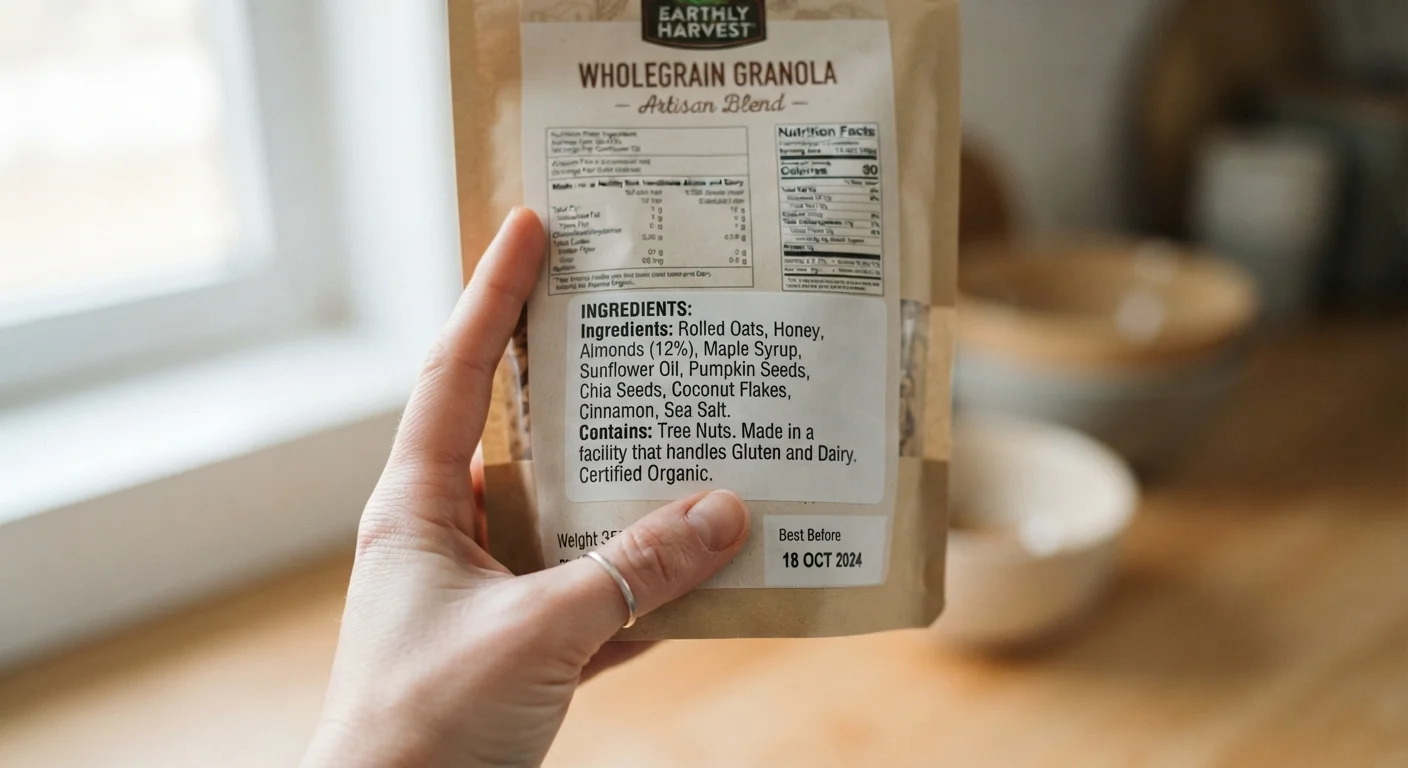
Photo credit: ResultsRover.com | Insights You Can Trust
In this article
Ingredient lists follow specific rules. Learn how to interpret order, spotting hidden sugars, and what common additive names actually refer to.
Key Takeaways
- Ingredients are listed by weight, so the first few ingredients dominate the product.
- Sugar appears under dozens of names - learning them helps you spot it quickly.
- Long ingredient names are not automatically harmful; some describe safe, well-studied additives.
- Ingredient order and the Nutrition Facts panel work together - read both for the full picture.
- Short ingredient lists do not always mean healthier; context and whole-food composition matter.
Why the Ingredient List Is Structured the Way It Is
In the United States, the Food and Drug Administration (FDA) requires that packaged food ingredient lists follow a specific rule: ingredients must be listed in descending order by weight. The ingredient that weighs the most in the final product appears first; the one that weighs the least appears last. This single rule is the most important concept for reading any ingredient list.
What this means practically: if whole wheat flour is listed first and sugar is listed second, wheat flour outweighs sugar in the recipe. If sugar appears first, it is the dominant ingredient by weight - even if the product is marketed as a nutritious option. This is why the top three to five ingredients deserve the most attention.
For a parallel look at how label language can inform or mislead in other consumer contexts, see our guide to reading product specifications.
What you will need
How to Identify Hidden Sugars
Added sugar is one of the most commonly discussed ingredients in nutrition, and food manufacturers use many names for it. The FDA requires added sugars to appear on the Nutrition Facts panel, but the ingredient list reveals the individual sources. Recognizing them by name helps you understand both how much sugar is present and how it was added.
Common sugar synonyms to look for include: high-fructose corn syrup, dextrose, maltose, sucrose, cane juice, evaporated cane juice, agave nectar, brown rice syrup, barley malt syrup, molasses, honey, and fruit juice concentrate. A product may list several of these separately, which can make total sugar content appear lower per individual ingredient than it actually is across the product as a whole.
The FDA's updated Nutrition Facts label now requires a dedicated "Added Sugars" line, so cross-referencing that number with the ingredient list gives you both the source and the quantity. For a deeper look at how added and natural sugars differ, see Added Sugar vs. Natural Sugar.
Allergen Names Can Be Hidden in Additive Terms
Some ingredient names conceal common allergens. For example, "hydrolyzed wheat protein" contains gluten, and "casein" is a milk-derived protein. If you or someone in your household manages a food allergy, always cross-check ingredient names with the bolded allergen statement required on U.S. labels - and consult a healthcare provider when uncertain.
Decoding Long or Unfamiliar Additive Names
Long chemical-sounding ingredient names can feel alarming, but length alone is not an indicator of risk. Many common additives have been reviewed and approved by regulatory agencies, and some - like ascorbic acid (vitamin C) or tocopherols (a form of vitamin E) - are nutrients you would recognize if listed by their common names.
Some categories worth knowing:
- Emulsifiers (e.g., lecithin, mono- and diglycerides): Help oil and water mix, maintaining texture.
- Preservatives (e.g., sodium benzoate, BHA, BHT): Extend shelf life by inhibiting spoilage.
- Colorings (e.g., annatto extract, caramel color, Red 40): Provide or maintain visual appearance.
- Stabilizers and thickeners (e.g., xanthan gum, carrageenan, guar gum): Improve consistency and mouthfeel.
Whether a specific additive is a concern for you personally depends on your individual health context - a question best answered with a registered dietitian or physician rather than a label alone.
Pair the Ingredient List With the Nutrition Facts Panel
The ingredient list tells you what is in a food; the Nutrition Facts panel tells you how much. Neither tells the complete story on its own. For a full breakdown of how to use the Nutrition Facts panel, see What the Nutrition Facts Label Is Actually Telling You.
Step-by-Step: Reading an Ingredient List at the Store
Follow these steps to get meaningful information from any ingredient list in under two minutes.
Find the ingredient list
Look for the ingredient list on the back or side panel of the package, usually directly beneath or near the Nutrition Facts label. By federal law, it must appear on virtually all packaged foods sold in the U.S.
Read the first five ingredients closely
Because ingredients are listed by weight, the first five ingredients make up the bulk of what you are consuming. Identify whether whole foods (like oats, whole wheat flour, or vegetables) or processed components (like refined flour, sugar, or oils) appear in these top positions.
Scan for multiple sugar names
Work through the full list and count how many sugar synonyms appear. Common ones include dextrose, maltose, cane juice, honey, corn syrup, and fruit juice concentrate. Multiple sugar forms spread across the list can add up to a significant total even if no single one appears near the top.
Look up unfamiliar additive names
If you encounter an ingredient you do not recognize, note it and look it up using a reliable source such as the FDA's food additive database or a registered dietitian's guidance. Many names that appear complex are simply chemical descriptions of familiar nutrients or widely used, approved substances.
Check the allergen statement
Below or at the end of the ingredient list, U.S. labels must declare the presence of the nine major food allergens (milk, eggs, fish, shellfish, tree nuts, peanuts, wheat, soybeans, and sesame) either within the ingredient list itself or in a separate "Contains" statement. Always read this section if you or someone you are shopping for manages a food allergy.
Cross-reference with the Nutrition Facts panel
Once you have reviewed the ingredient list, turn to the Nutrition Facts panel to verify quantities. An ingredient list shows you what is present; the panel shows you how much per serving. Together, they give a far more complete picture than either provides alone. For guidance on the Nutrition Facts panel, see our full breakdown of the Nutrition Facts label.

Author
Health & Wellness Editorial Team
Health & Wellness Editorial Team is the collective byline for our editorial team and contributor network. Articles published under this byline or an editorial pen name are researched, written, and reviewed according to our editorial standards for clarity, consistency, and independence before publication.
View all articles →