
Whole Grains vs. Refined Grains: What Changes When You Process a Kernel
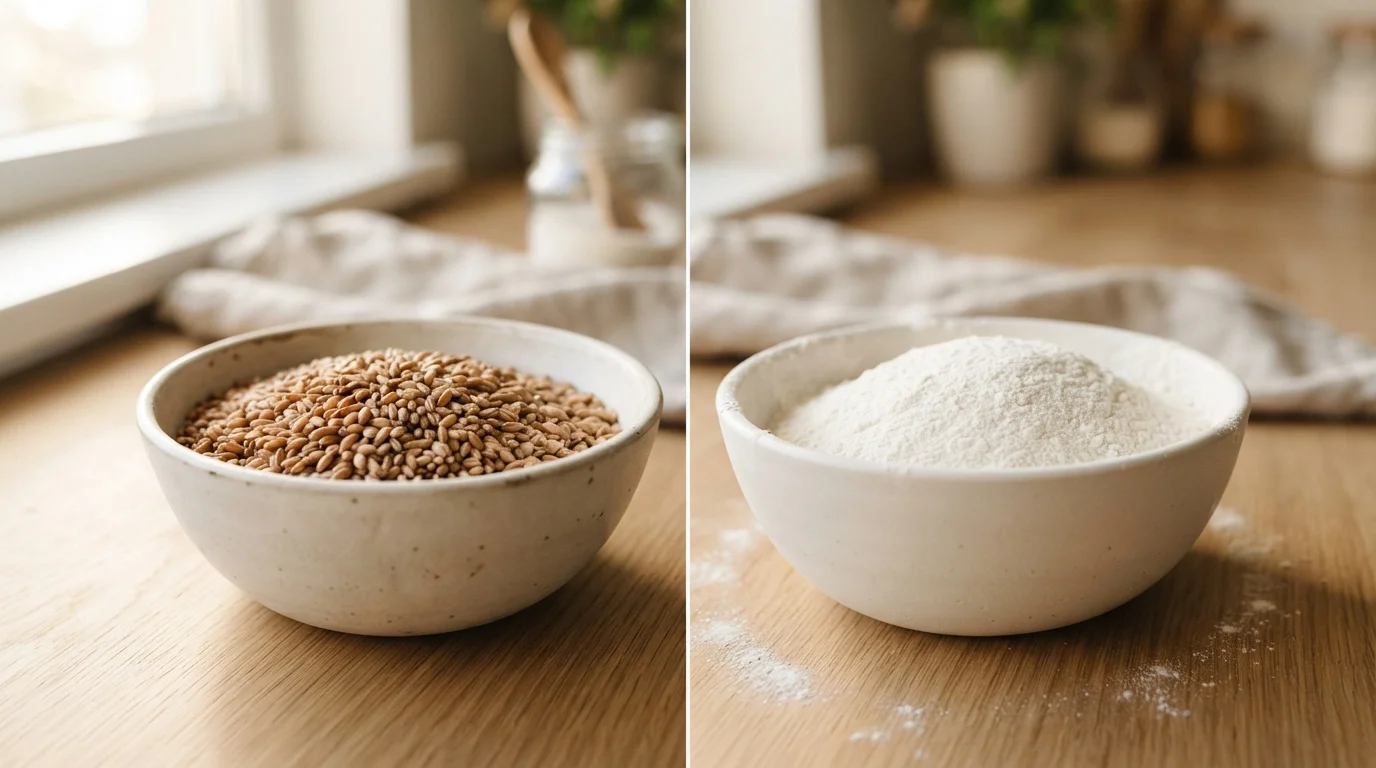
Photo credit: ResultsRover.com | Insights You Can Trust
In this article
See what's lost and what remains when whole grains are milled into refined flour, and why the distinction matters for everyday eating.
Key Takeaways
- Milling removes the bran and germ from a grain kernel, stripping most fiber, B vitamins, iron, and healthy fats.
- Refined grains digest more rapidly, which can cause quicker rises in blood glucose compared to their whole-grain counterparts.
- Enrichment adds back select B vitamins and iron but does not restore fiber, phytochemicals, or the full nutrient spectrum.
- Dietary guidelines from the U.S. Department of Agriculture recommend making at least half of daily grain servings whole grains.
- Switching even a portion of refined grains for whole grains is a practical, evidence-supported step for most adults.
What Happens Inside the Mill
A grain kernel is composed of three distinct layers: the outer bran, the nutrient-dense inner germ, and the starchy core called the endosperm. A whole grain retains all three. Refining strips away the bran and germ, leaving only the endosperm - the part richest in starch but poorest in micronutrients.
The bran contains most of a kernel's dietary fiber, along with B vitamins like thiamine, niacin, and folate, plus minerals including magnesium and phosphorus. The germ supplies vitamin E, healthy unsaturated fats, and additional B vitamins. When those two layers are removed, the resulting flour or grain product delivers calories and carbohydrates but far fewer of the compounds that support metabolic and digestive health.
This is not a subtle difference. A single serving of whole wheat bread typically provides two to three times the fiber of an equivalent serving of white bread made from refined flour.
| Criterion | Whole Grains | Refined Grains |
|---|---|---|
| Kernel layers retained | Bran, germ, and endosperm | Endosperm only |
| Dietary fiber per serving | Higher (2-4g+ typical) | Lower (under 1-2g typical) |
| Vitamins & minerals | Broad natural spectrum | Select nutrients added back |
| Glycemic response | Generally lower and slower | Generally higher and faster |
| Satiety effect | Greater, due to fiber content | Lesser, digests more quickly |
| Shelf life | Shorter (germ fats can oxidize) | Longer, more shelf-stable |
| Texture & palatability | Denser, heartier | Lighter, finer texture |
Enrichment: A Partial Fix
After refining, manufacturers in the United States are required to enrich most grain products by adding back specific nutrients - primarily thiamine, riboflavin, niacin, folic acid, and iron. This enrichment program, established decades ago, has meaningfully reduced deficiency-related conditions such as neural tube defects associated with low folate intake.
However, enrichment is selective. It restores a small set of nutrients lost during milling but does not replace fiber, vitamin E, magnesium, zinc, phytochemicals, or antioxidants. Think of it as returning a handful of items from a box that was largely emptied - useful, but not equivalent to the original.
Folic Acid Fortification: A Public Health Success
Since the FDA mandated folic acid fortification of enriched grain products in 1998, rates of neural tube defects in the United States have declined significantly. This underscores that enrichment can address specific public health gaps - even when it cannot replicate the full nutritional profile of a whole grain. The fortification program remains in place today, making enriched grains a reliable source of folic acid for people of reproductive age.
For everyday consumers reading food labels, "enriched" is not a synonym for "nutritionally complete." Checking the ingredient list for the word "whole" before the grain name (e.g., "whole wheat flour") is the most reliable shortcut to identifying a genuinely whole-grain product.
Blood Sugar, Satiety, and Digestion
Because refined grains lack fiber and are composed largely of rapidly digestible starch, they are broken down and absorbed into the bloodstream more quickly than whole grains. This translates to a higher glycemic response - a faster and often larger rise in blood glucose following a meal.
Whole grains, by contrast, slow gastric emptying and glucose absorption, contributing to steadier energy levels and a longer-lasting sense of fullness. The fiber in whole grains also serves as a substrate for beneficial gut bacteria, supporting microbiome diversity - an area of active and growing research in nutritional science.
~90%
Americans falling short of whole grain recommendations
Research published in nutrition surveillance data consistently estimates that roughly 90% of U.S. adults do not meet the recommended minimum of three servings of whole grains daily.
25%
Reduction in fiber during refining
Milling wheat into white flour can remove up to 75-80% of naturally occurring dietary fiber, according to grain-processing research.
3+ servings
Daily whole grain target per U.S. dietary guidelines
The Dietary Guidelines for Americans recommend adults consume at least 3 ounce-equivalents of whole grains per day as part of a healthy eating pattern.
It's worth noting that individual glycemic responses vary based on overall meal composition, cooking method, and individual physiology. These are population-level patterns, not guarantees for any one person. Consult a registered dietitian or healthcare provider for personalized dietary guidance.
Making the Switch: Practical Starting Points
Federal dietary guidance - specifically the DGA, published jointly by the USDA and HHS - recommends that at least half of all grain servings come from whole grains. For most Americans, current consumption falls well below that threshold.
Small, consistent substitutions tend to be more sustainable than wholesale dietary overhauls. Common entry points include choosing oatmeal over processed breakfast cereals, selecting whole-grain bread with fiber listed on the label, or substituting brown rice or farro for white rice a few nights per week. Whole-grain pasta, barley, and popcorn (an intact whole grain) are also accessible options.
Reading labels carefully remains essential. Terms like "multigrain," "wheat bread," or "made with whole grains" do not necessarily mean a product is predominantly whole grain. Look for a whole grain listed as the first ingredient.
This article is for general informational and educational purposes only and is not a substitute for professional medical or dietary advice. If you have specific health concerns or dietary needs, consult a qualified healthcare provider or registered dietitian.

Author
Health & Wellness Editorial Team
Health & Wellness Editorial Team is the collective byline for our editorial team and contributor network. Articles published under this byline or an editorial pen name are researched, written, and reviewed according to our editorial standards for clarity, consistency, and independence before publication.
View all articles →